





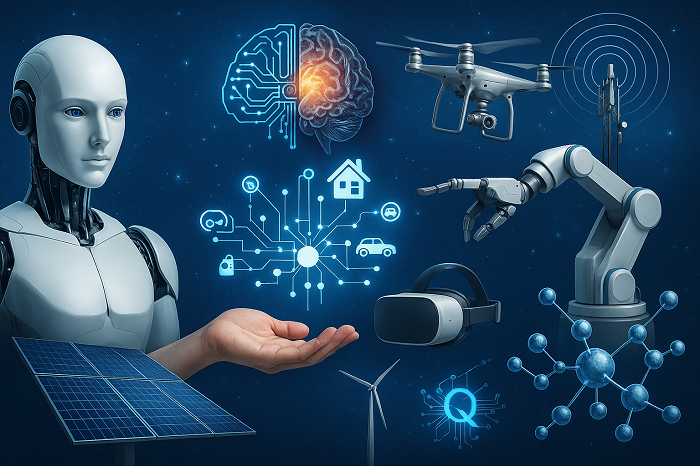
The pace of technological innovation in 2025 is transforming every aspect of our lives. From artificial intelligence and automation to quantum computing and the metaverse, the digital revolution is creating smarter, faster, and more connected systems than ever before. The year 2025 marks a new phase where emerging technologies are no longer futuristic concepts but real, impactful tools driving industries and societies forward. Understanding these developments is essential for anyone who wants to stay ahead of the curve in business, education, or everyday life.
1. The Rise of Artificial Intelligence and Generative AI
Artificial Intelligence remains the leading force behind the most groundbreaking innovations of 2025. What started as simple automation has evolved into generative AI systems capable of creating text, images, music, and even software code with astonishing accuracy. Tools powered by large language models have become mainstream, assisting businesses in content creation, customer support, and decision-making. Moreover, AI ethics and regulation are gaining importance as companies balance productivity with responsible usage. The integration of AI into healthcare, education, and financial systems shows how deeply it is shaping both the economy and human experience.
2. Quantum Computing Comes Closer to Reality
Quantum computing is no longer confined to theoretical labs. In 2025, breakthroughs in quantum chips and algorithms have brought us closer to practical applications. Companies like IBM, Google, and startups across the globe are racing to achieve quantum advantage—where quantum computers outperform classical ones in real-world tasks. Industries such as cybersecurity, pharmaceuticals, and climate modeling are expected to benefit first. For instance, drug discovery is becoming faster due to the ability of quantum systems to simulate molecular interactions in ways previously impossible. While mass adoption is still on the horizon, the groundwork laid in 2025 is setting the stage for a computing revolution.
3. Expansion of the Internet of Things (IoT) Ecosystem
IoT technology continues to grow exponentially in 2025, connecting billions of devices across homes, cities, and industries. Smart homes now feature fully synchronized ecosystems where lighting, security, energy, and appliances communicate seamlessly. In manufacturing, industrial IoT ensures predictive maintenance, reducing downtime and costs. Cities are becoming smarter with connected infrastructure that manages traffic, waste, and energy consumption efficiently. The rise of 5G and edge computing is fueling IoT’s scalability, allowing devices to process data faster and operate independently without relying heavily on cloud servers.
4. The Era of Edge Computing
Edge computing is one of the most influential tech shifts of 2025, especially as data generation reaches unprecedented levels. Instead of sending information to centralized cloud servers, edge computing processes data closer to its source. This results in faster response times, improved security, and reduced latency—crucial for applications such as autonomous vehicles, smart factories, and telemedicine. The collaboration between edge and cloud systems ensures that businesses can scale operations while maintaining performance and security. The evolution of edge AI, where artificial intelligence algorithms run on local devices, is making real-time decision-making more accessible and efficient.
5. Advancements in Renewable Energy Tech
The global focus on sustainability has accelerated technological progress in renewable energy. In 2025, innovations in solar cells, wind turbines, and energy storage have made renewable power more efficient and affordable. Smart grids powered by AI and IoT manage electricity distribution intelligently, reducing wastage and improving reliability. The introduction of solid-state batteries has improved energy density and reduced charging times for electric vehicles, marking a major milestone in the green tech revolution. Companies are increasingly adopting carbon-neutral technologies, and nations are racing toward net-zero emissions powered by advanced tech solutions.
6. The Evolution of Extended Reality (XR) and the Metaverse
Extended Reality, encompassing Augmented Reality (AR), Virtual Reality (VR), and Mixed Reality (MR), is reshaping digital experiences in 2025. With more immersive devices and faster processing power, XR is transforming industries such as entertainment, education, and real estate. Virtual collaboration environments have become standard for remote work, offering realistic meeting spaces and interactive training. The metaverse is evolving beyond gaming, with businesses creating virtual storefronts, social hubs, and digital workplaces. As XR integrates with AI, experiences are becoming more personalized, creating a new dimension of interaction between humans and technology.
7. Cybersecurity in the Age of AI
As digital transformation accelerates, cybersecurity has become one of the most critical areas of innovation in 2025. AI-driven cyber defense systems now predict and neutralize threats in real time, while zero-trust architectures protect sensitive data across networks. Quantum encryption is emerging as the next big leap in security, promising unbreakable data protection. Businesses are investing heavily in cybersecurity automation to counter sophisticated attacks. With remote work, IoT, and digital identities expanding, the need for strong, adaptive security systems has never been greater.
8. The Growth of Biotechnology and Human Augmentation
2025 marks a turning point in biotechnology, where advancements in genomics, CRISPR, and wearable devices are redefining healthcare. Personalized medicine powered by AI enables doctors to create tailored treatment plans based on an individual’s genetic data. Wearable health monitors provide continuous insights into vital signs, preventing illnesses before they escalate. Human augmentation technologies such as neural implants and robotic prosthetics are enhancing physical and cognitive capabilities. These innovations are not only extending lifespan but also improving the quality of life across populations.
9. Automation and Robotics in Everyday Life
Automation has moved beyond industrial use into daily routines. In 2025, robotics plays a vital role in logistics, agriculture, and domestic life. Autonomous drones deliver goods, robotic assistants handle household chores, and AI-powered agricultural robots increase food production efficiency. Businesses rely on robotic process automation (RPA) to streamline operations and reduce costs. The synergy between AI, robotics, and IoT ensures that these systems are smarter, safer, and more adaptable than ever before. As technology evolves, robots are becoming true collaborators rather than mere tools.
10. 6G and the Future of Connectivity
While 5G continues to expand globally, research and early trials for 6G are already underway in 2025. Promising speeds up to 100 times faster than 5G, 6G networks will power next-generation applications such as real-time holographic communication and ultra-high-definition virtual environments. The technology will also support massive IoT ecosystems and seamless integration of AI into network management. This level of connectivity will revolutionize everything from telemedicine to entertainment, setting a new benchmark for global communication.
Conclusion
The top 10 tech trends shaping the future in 2025 demonstrate how technology is redefining innovation, sustainability, and human interaction. From the rise of AI and quantum computing to the emergence of XR, biotechnology, and next-gen connectivity, these trends are paving the way for a smarter and more connected world. Businesses, governments, and individuals that embrace these advancements will be better positioned to thrive in the evolving digital economy. The future is being built today, and understanding these trends is the key to unlocking the opportunities of tomorrow.
Frequently Asked Questions (FAQs)
Q1. What is the biggest technology trend in 2025?
Answer. Artificial Intelligence, particularly generative AI, is the most influential trend in 2025 due to its widespread impact across industries like education, healthcare, and business automation.
Q2. How is quantum computing changing industries?
Answer. Quantum computing enables faster data processing and complex problem-solving, benefiting sectors like drug discovery, cybersecurity, and climate modeling.
Q3. What role does IoT play in smart cities?
Answer. IoT connects devices and infrastructure, helping cities manage traffic, waste, and energy efficiently, creating safer and more sustainable urban environments.
Q4. Is 6G technology available in 2025?
Answer. While 6G is still in the development phase, early trials and prototypes are being tested globally to prepare for commercial rollout by 2030.
Q5. Why is cybersecurity so critical in 2025?
Answer. With increasing digital transformation and remote work, cybersecurity ensures data protection, privacy, and safe online interactions amid growing AI-driven threats.
Q6. How will XR and the metaverse affect daily life?
Answer. XR technologies will make digital interactions more immersive, transforming education, gaming, social communication, and virtual business environments.








Comments are closed